chess Moves
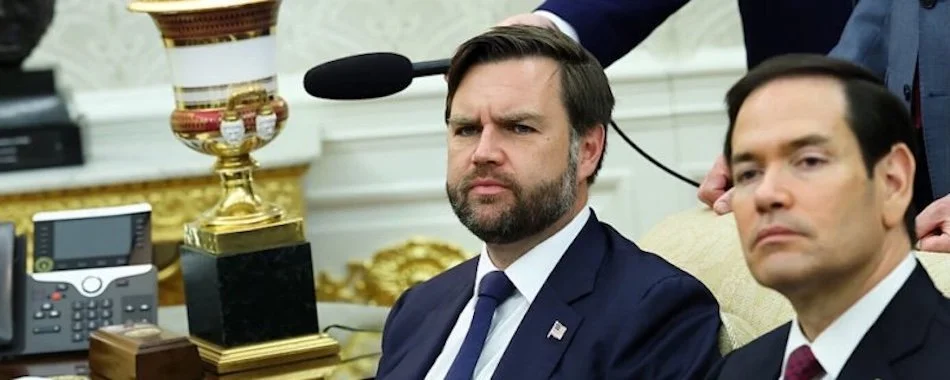
ELON MUSK BACKS JD VANCE AGAINST NETANYAHU
WHILE MIRIAM ADELSON (MARCO RUBIO'S GODMOTHER) ATTACKS TRUMP
by Alfredo Jalife-Rahme
Iran and the President of the United States have defeated Israel and the backers of its genocides. Consequently, the peace concluded by Washington and Tehran has sparked a new war—this time among Donald Trump’s supporters over his succession.
VOLTAIRE NETWORK | PARIS (FRANCE) | 28 JUNE 2026
In my interview on the Spanish television channel NegociosTV (Lebanon: The "Balkans of the Middle East" [1]), I argued that the "Islamabad Memorandum"—signed by Presidents Trump (at the Palace of Versailles) and Pezeshkian of Iran—shook the very foundations of the Middle East and, as
might be expected, sparked discord and rifts within the United States itself, as well as in Israel and Iran (according to assessments by former British diplomat Alastair Crooke during his interview with the Norwegian Glenn Diesen [2]).
As I had posited, former Russian President Dmitry Medvedev declared that control over the Strait of Hormuz represents one of Iran’s true "atomic bombs": "It is unclear how the truce between Washington and Tehran will take shape. But one thing is certain: Iran has already tested its first nuclear weapon. It is called the Strait of Hormuz. Its potential is inexhaustible" [3]. The Strait of Hormuz has proven to be the epicenter of global geoeconomics and geofinance. As for the other metaphorical "nuclear asset"—control of the Bab el-Mandeb Strait by the Yemeni Ansarallah guerrillas, Iran’s allies—it has not yet been deployed.
Indeed, the scrapping of the Joint Comprehensive Plan of Action (JCPOA)—an agreement associated with the Obama-Biden era—and Trump’s two successive confrontations with Iran (three catastrophic choices prompted by Prime Minister Netanyahu) have ultimately driven the U.S. President to the edge of an "economic precipice." This situation is reminiscent of the "Great Depression" triggered by Herbert Hoover—a comparison Trump himself drew during a relevant press conference on the sidelines of the G7 summit in Évian. Ill-advised by Netanyahu, Trump exhausted his military options and was left with no choice but to negotiate with Iran. Beyond the balkanization of Syria advocated by The Jerusalem Post [4]—which Israel is attempting to implement, starting with military operations in Lebanon—the U.S.-Iran deal has irreparably fractured the Republican Party’s 2028 presidential nomination race between J.D. Vance (JDV) and Marco Rubio (MR).
In a post on X—the platform owned by Elon Musk—the user @GeneralMCNews shared the following (which has yet to be denied!): “BREAKING: Elon Musk says he agrees with JD Vance’s warning to Israel” [5]. Most significantly, the same sentiment appears on @ElonMusk’s own account, in a post that highlights the matter by referring to “valid points” [6].
Vice President JD Vance defended both President Trump and the deal, and sharply criticized the Talmudic zealots Itamar Ben Gvir—Minister of Security (sic)—and Finance Minister Bezalel Smotrich, though without mentioning Prime Minister Netanyahu (beware of reprisals!). He warned Israel that "right now, Trump is the ONLY head of state in the ENTIRE WORLD who is still friendly toward Israel, and it just so happens that Trump is also the head of state of the global superpower." [7]. The late Israeli power broker Sheldon Adelson—well known for the many skeletons in his closet [8]—and his widow, the geneticist and pro-genocide advocate Miriam Adelson, had supported the pro-Israel former Mormon Marco Rubio against Trump during the 2016 Republican primaries [9]. Trump, the candidate at the time, had mocked Marco Rubio, calling him "Adelson’s puppet" because he had been well-greased by substantial "donations."
The Israel Hayom newspaper, owned by Miriam Adelson—the genocide enthusiast who became the second-largest donor to Trump’s campaign (trailing only Elon Musk) following Sheldon’s death in 2021—goes straight for Trump’s jugular, declaring: "You could have been the greatest president of all, but you failed" [10]. The paper attacks him for "betraying Israel" and, having rejected the "surrender deal," accuses its (former?) ally Trump of "undermining Israel’s security and weakening the United States." In his own peculiar, sarcastic style—which perhaps betrays deep nervousness—Trump retorted that "Vance can pay the price for the Iran settlement" [11]. There is still much to unfold...
The largest Spanish-language daily newspaper in the world.